
If you an individual looking for AI literacy training, please head over to The Inclusive AI Lab!
Organizations: Book a call to chat about upskilling your staff today
- Do you want to ensure your staff are ready to implement AI projects?
- Do you want to skill up your staff in finding robust, responsible uses of AI in your organization? Consider an intensive bootcamp or a dispersed bootcamp across 3 months.
- Are you rolling out a chatbot and ready for testing? Get your team ready for beta testing! I build custom trainings to ensure your investment in an AI build is utilized to its full value.
- Do you want to get hands-on, interactive workshops to solidify staff learning while saving budget? Consider purchasing multiple seats for on-demand training (through The Inclusive AI Lab) and add live, facilitated hands-on workshops where your staff can work together to uncover the pros, and cons, of AI and learn how to best harness it for positive social impact! Up to 22 activities and discussions can be facilitated for a custom AI literacy experience tailored to your organization’s needs.
Custom training can be delivered remote or in-person and at the time of your choosing.
Sign up here for a free 30 min consultation to discuss what might be right for your organization.
AI literacy training for non-technically trained professionals
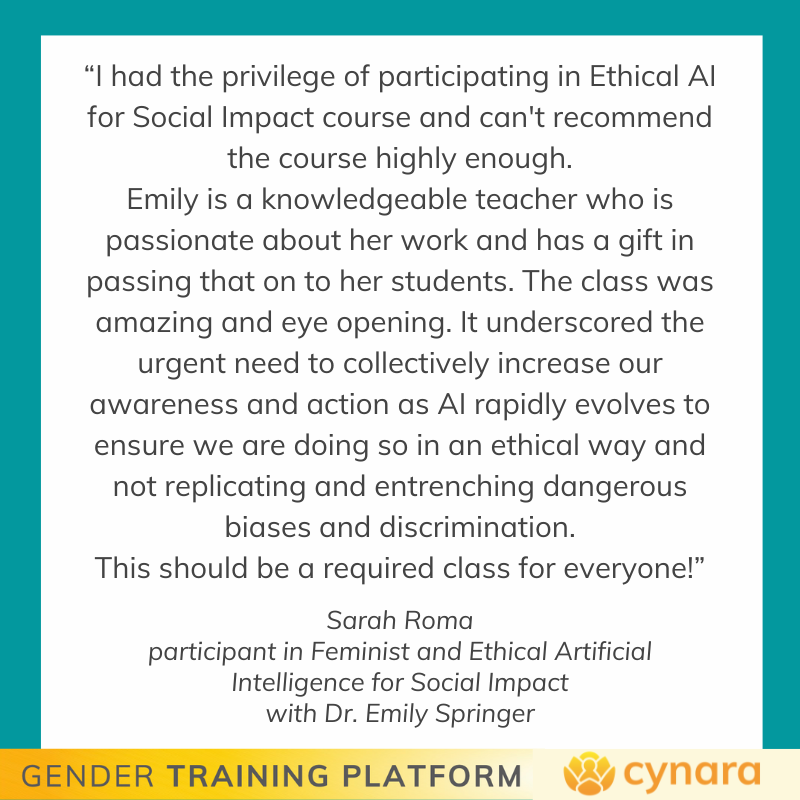
I offer comprehensive algorithmic literacy training to individuals and organizations, focused on upskilling non-developers and non-coders to meaningfully contribute to AI builds. This is not a mere “tips and tricks” AI literacy program. Instead, I will train you how to critically think, assess, and utilize AI in your workflows, and to do so responsibly with social inclusion and risk mitigation in mind. I focus on breaking down complex topics into understandable and bite-sized learnings, iteratively building knowledge and comprehension of AI topics, concepts, and important debates.
My former participants go on to give speeches on AI, provide thought leadership on AI uses, and build AI products with their teams! This is my metric of success.
Delivery options
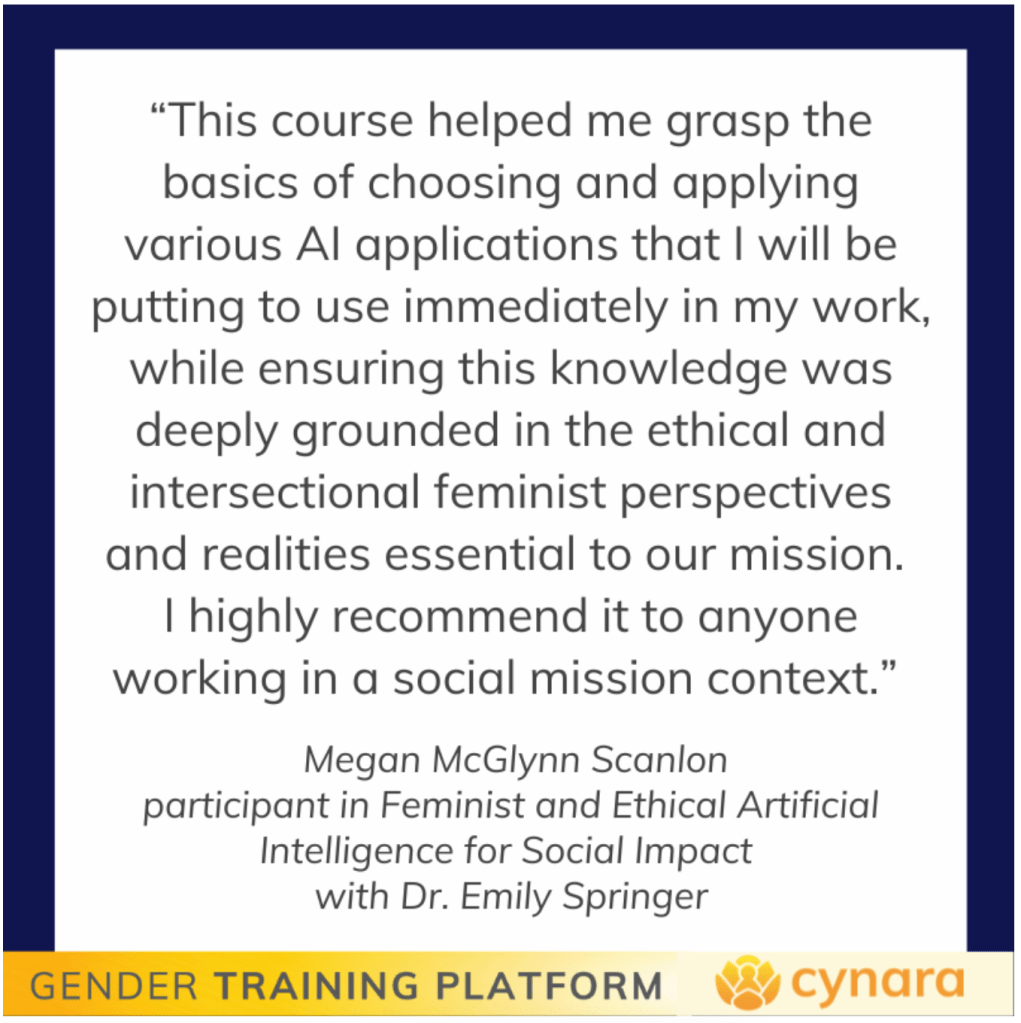
For organizations, I create and deliver custom options to fit your needs. My base offerings include Responsible AI for Social Impact professionals in two formats:
OPTION 1:
An intensive Responsible AI bootcamp that requires approximately 20 hours per week for two weeks.
OPTION 2:
A 3-month Responsible AI program that requires just 2.5 hours per week for your participating staff.
These offerings can be further customized to meet your needs, either in topics covered and/or pacing and time commitment.
Full Bootcamp Overview (intensive or 3 months)
Grow your algorithmic literacy! If you are a non-technical practitioner, you are absolutely needed at the AI table! Learn the basics, gain skills, and build confidence to engage in social impact projects with machine learning components. If you work in gender & social inclusion support, proposal development, program design, backstopping, and other non-technical areas, this training is for you.
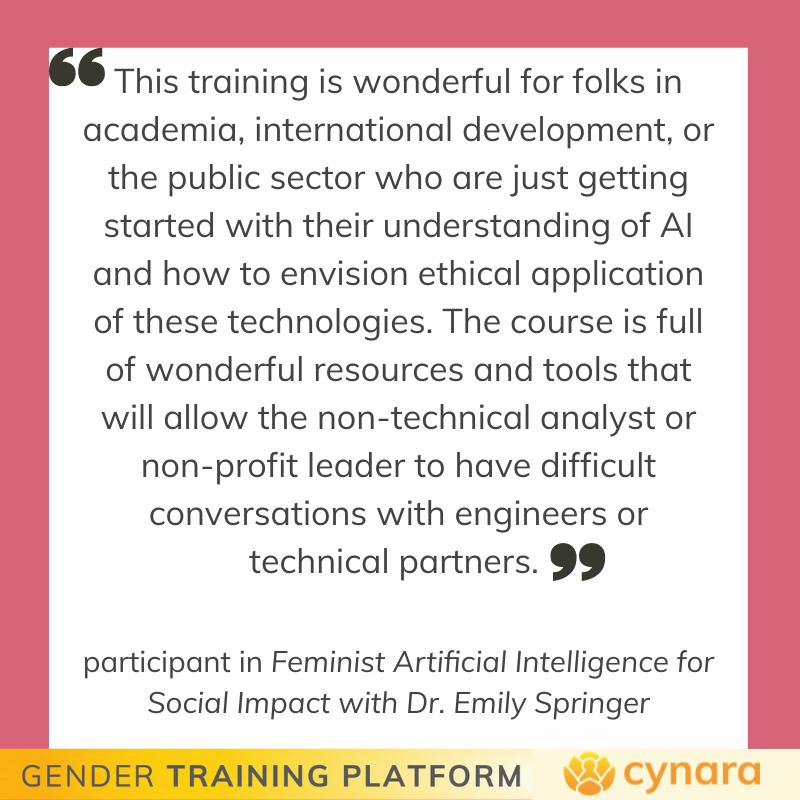
This training assumes no understanding of algorithms and will use conceptual understandings, rather than statistical or data science approaches, to upskill you in this rapidly evolving technology. We will learn how machine learning algorithms operate, explore challenges around bias, ethics, and inclusion, and review development use cases. We will finish with best practices and examples of harnessing the power of machine learning for gender equity and social inclusion.
This course will empower you to understand, advocate for, and address ethical AI concerns broadly and gender equality, social inclusion, diversity, and equity concerns specifically. You will emerge with a greater ability to read and apply USAID guidance and constructively collaborate with coders/developers for successful machine learning for social impact projects.
Notes to participants:
(1) no statistics required! We will work from conceptual and layperson understandings,
(2) we will use examples from data-rich U.S. to understand ethical concerns before applying these to international development and social sector cases.
Training topics deep dive
Intro to AI, inequalities, and machine learning models
A rapid introduction to the core understanding the fight for social justice and equality in the evolving context of artificial intelligence and automation. A conceptual introduction to machine learning models (supervised, unsupervised, reinforcement, and neural nets) and terms such as structured/unstructured data, data labeling, and optimization. We will finish the day with an activity and discussion where we train our own (supervised learning) algorithm to both apply the terms and critically interrogate the results.
Understanding data bias through neural nets
Data is not the only source of bias, but it’s definitely an important one! Using case studies, review how data inequality embeds into algorithmic performance. Debate the potentials and pitfalls of “we just need more data” as the most logical solution. Dive into the opaque world of neural net weights and biases. Play Pictionary with a neural net to understand data bias. Learn about efforts to enhance datasets and examples of datasets gone wrong.
Righting wrongs? The need for content moderation and fairness and bias metrics
Move newfound neural nets knowledge to practice by considering ChatGPT and its training data in the context of existing social norms. Learn about how content moderation and the work that precedes it. Dive into the world of algorithmic auditing by asking: What do we mean when we say fair? An overview of dominant fairness metrics, the confusion matrix, and its role in assessing accuracy. Move this into practice with a demo of a bias mitigation tool and a peek at other fairness-testing solutions.
AI Regulation and the task of localizing Global AI Ethics
Broad overview of regulatory efforts in the Global North (with a focus on EU AI Act and the US’ White House Bill of Rights) and efforts of OECD in ethical AI. Rapid review of Global South interests, regulations, and state of AI. If time allows: discuss the importance of functional use in determining ethical AI use.
Moving to practice: implementing AI in projects and organizations (nudging as a case of implementation)
Review of the software development lifecycle and the importance of cross-functional teams that include you. Highlights from USAID’s suite of machine-learning related reports and guidance materials (2016-2021). Review Nobel Prize winning theory of nudging and consider how the development sector might be tempted to use it. Close by considering best practices in applied use cases.
Toward Responsible AI in practice
Come with an example of a ML/AI application in your area of interest for the group to discuss and debate. Trainer will present an alternative use of machine learning to address inequalities. Opportunity to catch up on material if discussions have been rich throughout the training. Time to answer questions, reflect, and decide if, what, and how we want to keep the momentum going!
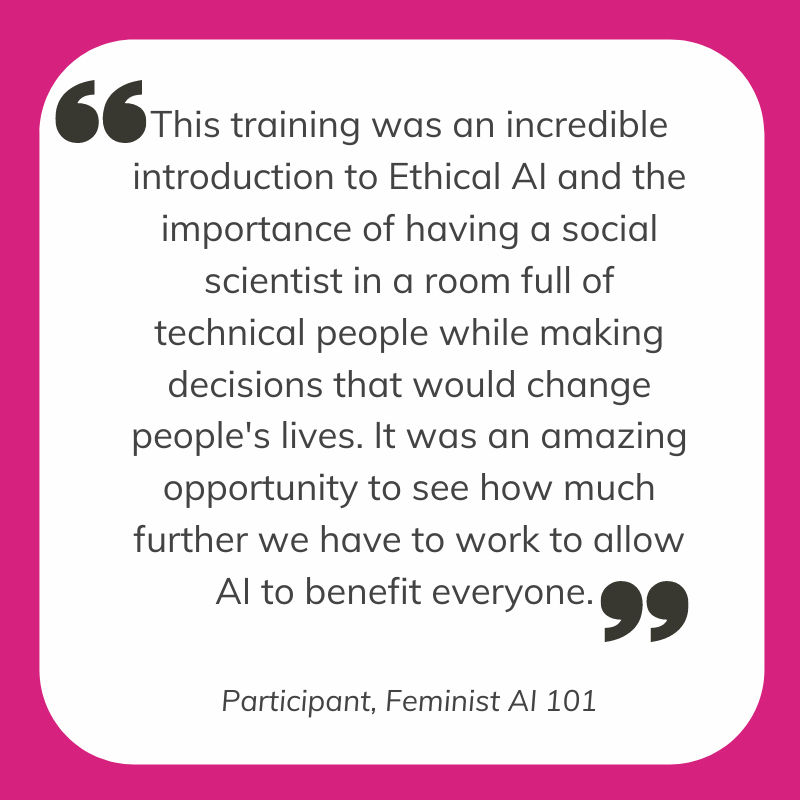
Participant testimonies

 TechnoSocio Advisory